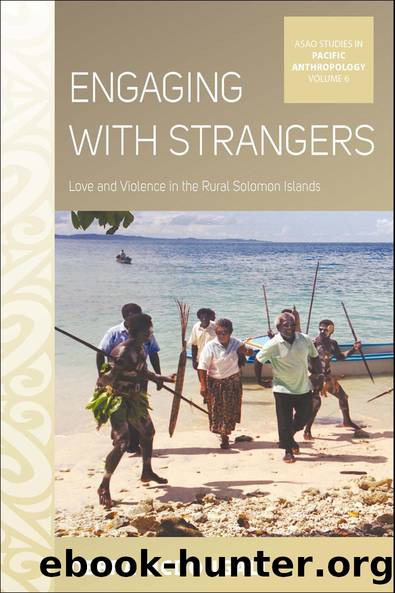
Engaging with Strangers by Debra McDougall
Author:Debra McDougall [McDougall, Debra]
Language: eng
Format: epub
Tags: Social Science, Anthropology, Cultural & Social
ISBN: 9781785330209
Google: 4oDjsgEACAAJ
Publisher: Berghahn Books
Published: 2016-01-15T04:22:38+00:00
Figure 5.4. The grave of Lokasasa, with a painted cross and a bakia embedded in the cement. The grave is within a âpermanent materialâ house with a cement foundation and low walls, louvered windows, and galvanized iron roof. 20 December 2000.
Figure 5.5. Helena Enaduri speaking in front of baskets (topa) labelled for distribution at the cementing of the graves of Matiu and Lisa of Kolomali. 4 January 2007.
âCementingâ Claims to Property in Funerals
Although I witnessed few events that were actually said to be pajuku ceremonies, a variety of rituals followed a logic similar to that described for pajuku. Many of these occurred in the context of mortuary rituals, especially the final ceremony in which the grave of the deceased is cemented, often with an elaborate headstone. With a few exceptions, the dead on Ranongga are buried in their family hamlets. People bury kin nearby because they want to be near to them and to keep them company; the practice also ensures that there is an unambiguous and durable sign of previous occupancy. Indeed, if old shrines with their heavy bakia âanchoredâ people in place, today Christian graves serve to âcementâ claims of descendents on the property of the deceased.
The cementing (sementi) of the grave occurs a year or more after the death. Earlier parts of the funeral cycle are hosted by the butubutu of the deceased, often with the assistance of the dead personâs children regardless of whether the deceased was a woman (and the children are of her butubutu) or a man (and they are vinapodo, âborn of,â the butubutu). On the tenth day after the death, for example, the entire community gathers to carry gravel to cover the grave, and then people of the deceasedâs butubutu present baskets of food to all the relatives who have helped. The division between the butubutu of the deceased and the children of the deceased is more marked, however, in the final rituals for important men. These cementing rituals are often hosted and organized by the deceased manâs children; the most important recipients of gifts of food and money are often their fatherâs butubutu, as well as his other kinspeople who might have claims on the property that their father created over the course of his life.
In 2000, I attended the cementing of the grave of Lokasasa, who was in his mid-nineties when he died the previous year. He had been particularly energetic in clearing forest, planting coconuts, and establishing hamlets on both Ranongga and on Vella Lavella, the land of his matrilineal ancestors. He was buried in Subolai village in Vella, and this was where the cementing ceremony was held. Lokasasa had been married three times; his second wife had been a woman of Malaita whom he met while working as a policeman during the period of Maasina Rule. She returned with him to Lale, but eventually returned home to Malaita, leaving behind their children with no connection to any matrilineal territoryâthough this would have probably also been the case even
Download
This site does not store any files on its server. We only index and link to content provided by other sites. Please contact the content providers to delete copyright contents if any and email us, we'll remove relevant links or contents immediately.
Spell It Out by David Crystal(36251)
Life for Me Ain't Been No Crystal Stair by Susan Sheehan(35914)
The Great Music City by Andrea Baker(33955)
Cecilia; Or, Memoirs of an Heiress — Volume 1 by Fanny Burney(32743)
Cecilia; Or, Memoirs of an Heiress — Volume 2 by Fanny Burney(32106)
Cecilia; Or, Memoirs of an Heiress — Volume 3 by Fanny Burney(32089)
Professional Troublemaker by Luvvie Ajayi Jones(29782)
The Secret History by Donna Tartt(19501)
We're Going to Need More Wine by Gabrielle Union(19213)
Twilight of the Idols With the Antichrist and Ecce Homo by Friedrich Nietzsche(18792)
All the Missing Girls by Megan Miranda(16806)
Cat's cradle by Kurt Vonnegut(15581)
For the Love of Europe by Rick Steves(14996)
Pimp by Iceberg Slim(14814)
Bombshells: Glamour Girls of a Lifetime by Sullivan Steve(14239)
Norse Mythology by Gaiman Neil(13622)
Talking to Strangers by Malcolm Gladwell(13576)
Fifty Shades Freed by E L James(13371)
The Social Justice Warrior Handbook by Lisa De Pasquale(12310)
